
Blackjack is a game of mathematical decisions, but successful play involves more than simply memorizing a basic strategy chart. Understanding the rules, house edge, card composition, table conditions, bankroll management, and the strengths and limitations of different approaches can help you make more disciplined decisions at the table.
Blackjack 101 is BeatTheCasino’s approach to building that foundation. Over the years, our discussions have covered everything from basic strategy and card counting to game selection, shuffle conditions, money management, and what we call Zero Proximity Blackjack.
This guide brings those concepts together in one place. Whether you’re learning blackjack for the first time or you’ve played for years, the goal is to understand why different blackjack strategies work, where they have limitations, and how to evaluate the game you’re actually sitting in.
What Is Card Clumping in Blackjack?
Blackjack 101 begins with a different way of looking at the game. Instead of assuming that every section of a multi-deck shoe will behave as though the cards are perfectly mixed, we pay attention to how the cards are actually coming out of the shoe.
We call this card clumping.
A clump is a recognizable grouping or sequence of cards with similar characteristics. For example, a shoe may produce a run dominated by high cards, another section dominated by low cards, or a pattern in which high and low cards alternate.
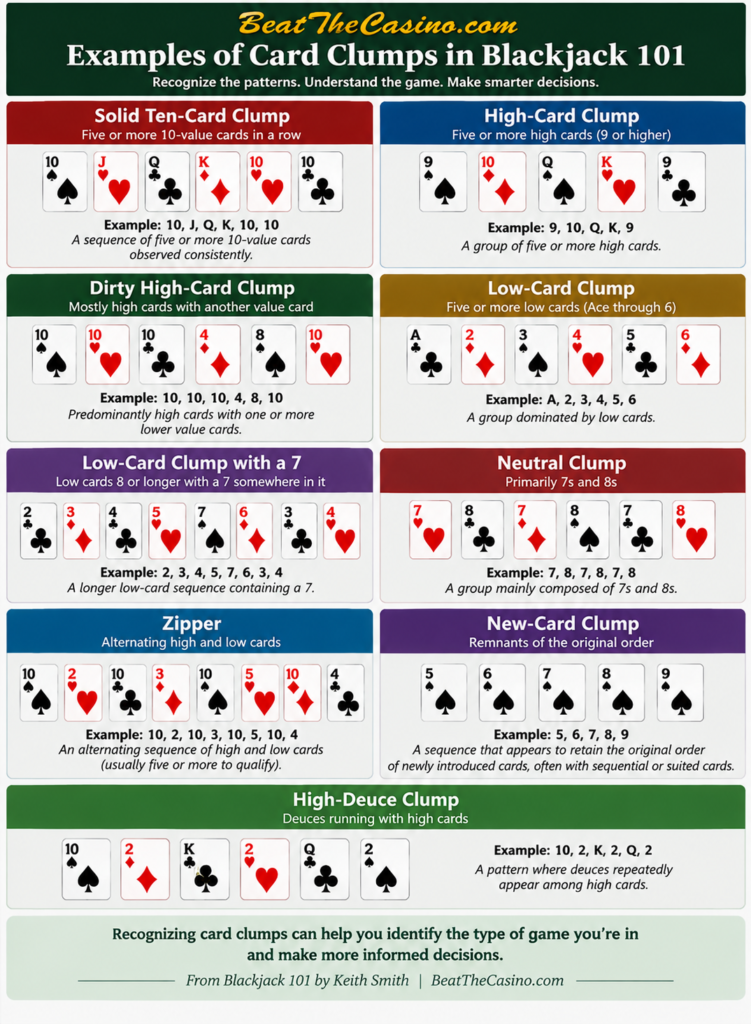
In Blackjack 101, we classify several types of card clumps, including high-card clumps, low-card clumps, solid ten-card clumps, dirty high-card clumps, neutral clumps, zippers, and remnants of new-card order.
Why does this matter?
Because Blackjack 101 is not based on blindly abandoning Basic Strategy. The objective is to first determine whether the cards are displaying an identifiable pattern.
If there is no identifiable pattern and the cards appear random, we play traditional Basic Strategy.
When a recognizable pattern does appear, however, Blackjack 101 teaches the player to consider that additional information when evaluating the table and making playing decisions.
This is the foundation of the Blackjack 101 approach: observe first, identify the type of game you’re actually in, and then decide how to play it.
Evaluating the Table: Dealer Break Ratio and APC
Before committing money to a blackjack table, Blackjack 101 teaches players to observe the game first. Two measurements used in the system are the Dealer Break Ratio (DBR) and Average Dealer Point Count (APC).
The Dealer Break Ratio measures how frequently the dealer busts during the observation period. For example, if the dealer busts 4 times during 10 observed hands, the DBR would be 40%.
APC looks at the dealer’s average finishing hand. To calculate it, Blackjack 101 assigns a value of 22 to dealer busts and uses the dealer’s actual total for completed hands from 17 through 21. Those results are averaged over the observation period.
These measurements are used as table-selection indicators within the Blackjack 101 methodology. Rather than sitting down simply because a seat is available, the idea is to observe the shoe and look for conditions the system considers favorable before deciding whether to play.
Blackjack 101 originally used DBR and APC as part of this qualification process. As the methodology developed further into Zero Proximity Blackjack, table selection, count range, card distribution and identifying what we call “windows of opportunity” became even more important.
Reading the Dealer’s Hand Through Card Clumps
Once Blackjack 101 identifies a clumped game, the next step is paying attention to the cards surrounding the dealer’s hole card.
The methodology looks at the exposed cards dealt immediately before the dealer’s hidden card and asks a simple question: Are those cards predominantly high, predominantly low, or mixed?
For example, if several low cards appear immediately before the dealer’s hole card during a shoe that has repeatedly produced recognizable low-card clumps, Blackjack 101 treats that history as additional information suggesting that the dealer’s hidden card may also belong to that low-card sequence.
The same concept can be applied to high-card clumps.
This is not treated as certainty. Blackjack 101 describes itself as a dynamic strategy because the interpretation depends on what has already occurred in that particular game. The history of the shoe, the length of the clumps previously observed, the number of players, and the cards surrounding the dealer’s hole card all contribute to the decision.
The objective is therefore not simply to look at one card and predict the next. It is to observe the structure of the shoe and determine whether the current sequence resembles patterns already observed in that game.
Why First Base Matters in Blackjack 101
Seat position becomes important in Blackjack 101 because the cards at the end of one round can provide information about the cards that may begin the next round.
This is particularly relevant at first base, the first player position to receive a card after the dealer begins a new round.
Suppose the end of a round produces a recognizable sequence of high cards. Blackjack 101 teaches the player to compare that sequence with the high-card clumps already observed during the shoe and consider whether the sequence may continue into the next round.
If the player believes the high-card clump is continuing, first base becomes especially interesting because that player receives the first card from the new round.
The methodology also considers the dealer’s exposed card and the cards surrounding the dealer’s hole card. If the developing sequence suggests that high cards may continue through the players and into the dealer’s hand, that information becomes part of the decision-making process.
The important concept is proximity: where you are seated determines which portion of an observed card sequence is most likely to reach your hand.
This idea eventually became an important bridge between the original Blackjack 101 methodology and the later development of Zero Proximity Blackjack.
From Blackjack 101 to Zero Proximity Blackjack
Blackjack 101 established the foundation: observe the cards, identify clumping patterns, evaluate the table, and adjust your approach according to the conditions you believe are developing in the shoe.
Zero Proximity Blackjack developed those ideas further.
Rather than focusing on a single measurement, Zero Proximity brings several observations together. These include the range of the count, table selection, number of players, seat position, dealer break rate, direction of the count, and the percentage and type of card clumping being observed.
The objective is to identify what we call windows of opportunity—periods within a shoe that the methodology considers more favorable for a particular type of play.
An important part of the concept is knowing when not to play. Instead of treating every hand or every table as an opportunity, the system emphasizes observing conditions and waiting for the circumstances the methodology is designed to identify.
That evolution is why today’s Blackjack 101 material goes considerably beyond the original forum discussions from the early days of BeatTheCasino.
The complete updated Blackjack 101: Zero Proximity Blackjack manual is available to BeatTheCasino Diamond Forum members.
Blackjack 101 vs. Traditional Card Counting
raditional card counting tracks the changing composition of the cards remaining in the shoe. As high and low cards are dealt, the count is used to estimate when the remaining cards may become more favorable or unfavorable to the player.
Blackjack 101 looks at the shoe differently.
While the methodology can use card-count information, its primary focus is on where cards appear to be grouped within the shoe and how those groups are being dealt at the table.
That distinction becomes even more important in Zero Proximity Blackjack. The methodology considers not only the count, but also the direction of the count, the range through which it has moved, the observed clumping percentage, the number of players, dealer results, and the player’s position at the table.
In other words, two shoes could reach a similar conventional count while displaying very different card distributions. Blackjack 101 and Zero Proximity attempt to distinguish between those situations rather than treating the count alone as the complete picture.
This is also why observation and game selection play such a large role in the system. The objective isn’t to force a strategy onto every blackjack table. It is to identify the particular conditions the methodology was designed around and act only when those conditions appear.
Types of Card Clumps in Blackjack 101
Blackjack 101 does not treat every group of cards as the same. The methodology classifies recurring card sequences according to the types of cards appearing together.
Some of the principal patterns described in Blackjack 101 include:
Solid Ten-Card Clumps: Sequences containing five or more consecutive 10-value cards when this pattern is observed consistently.
High-Card Clumps: Groups of five or more predominantly high cards. In Blackjack 101, cards valued 9 and above are classified as high cards.
Dirty High-Card Clumps: Predominantly high-card sequences interrupted by one or more cards of another value. The sequence isn’t perfectly “clean,” but the concentration of high cards remains noticeable.
Low-Card Clumps: Groups dominated by low cards. Blackjack 101 classifies Ace through 6 as low cards and also discusses longer low-card sequences containing an occasional 7.
Neutral Clumps: Groups primarily composed of 7s and 8s, which Blackjack 101 treats as neutral cards.
Zippers: Alternating sequences of high and low cards. An example might look like 10, 2, 10, 3, 10, 5, 10, 4. Blackjack 101 uses a minimum sequence length before considering the pattern a zipper.
New-Card Clumps: Sequences that appear to retain remnants of the original ordering of newly introduced cards, sometimes including cards remaining in sequential or suited groups.
High-Deuce Clumps: A pattern described in the manual in which deuces repeatedly appear among concentrations of high cards.
Learning to recognize these different patterns is important because Blackjack 101 does not simply ask, “Are the cards clumped?” It asks what kind of clump is appearing, how long it has been running, and whether similar patterns have already appeared during the shoe.
When Do You Use Basic Strategy?
One of the most important principles in Blackjack 101 is knowing when not to make a clump-based adjustment.
Seeing a few high or low cards does not automatically mean that a meaningful clump has been identified. Blackjack 101 teaches the player to consider the history of the shoe, the length and type of previously observed clumps, the cards currently being dealt, and whether a recognizable pattern is actually present.
When you cannot identify what is coming and the cards appear random, Blackjack 101 calls for traditional Basic Strategy.
That makes Basic Strategy the foundation and fallback of the system rather than something Blackjack 101 simply discards.
When the methodology identifies a recognizable clump, it may call for a different decision based on the cards believed to be surrounding the player’s or dealer’s hand. When those conditions cannot be identified with sufficient confidence, the player returns to Basic Strategy.
This distinction is important because Blackjack 101 is intended to be dynamic. The approach changes according to the conditions being observed rather than applying the same alternative decision to every hand.
That is closely aligned with the manual’s own instruction that when you do not know what is coming, you play Basic Strategy, while its clump-based decisions depend on the history and conditions of the particular game.
Get the Updated Blackjack 101: Zero Proximity Blackjack Manual
The original Blackjack 101 methodology has continued to develop since these concepts were first introduced within the BeatTheCasino community.
Today, BeatTheCasino Diamond Forum members receive access to the updated Blackjack 101: Zero Proximity Blackjack manual, which takes the concepts discussed in this article considerably further.
The complete manual goes deeper into table selection, card clumping, count range and direction, player position, dealer results, identifying windows of opportunity, and the playing concepts used within the Zero Proximity methodology.
Diamond membership also provides access to the private Diamond Forum and additional Baccarat and Blackjack educational resources available to members.
If you want to study the complete Blackjack 101 and Zero Proximity methodology, join the BeatTheCasino Diamond Forum and access the current manual.
The Blackjack 101 Approach
Blackjack 101 has always been about looking beyond a single hand and paying attention to the game as it develops.
The methodology combines observation, card-clump recognition, table selection, dealer results, player position, Basic Strategy, and card-count information to evaluate the conditions occurring in a particular shoe.
The central idea is simple: observe first and play second.
If the cards appear random and there is no identifiable pattern, use traditional Basic Strategy. If recognizable clumping conditions develop, Blackjack 101 teaches players to evaluate those conditions using the history of the shoe and the concepts described in the methodology.
Zero Proximity Blackjack takes that approach further by bringing additional variables together in an attempt to identify the specific situations we call windows of opportunity.
No blackjack methodology eliminates risk or guarantees a winning session. Blackjack results involve variance, and players should never wager money they cannot afford to lose.
For more than two decades, the BeatTheCasino community has discussed and developed approaches to Baccarat and Blackjack through real-world play, member discussion, and continued study of casino games.
Continue the discussion: Read the original Blackjack 101 forum discussion on the BeatTheCasino Players Forum.
If you want to study the complete Blackjack 101 and Zero Proximity methodology, join the BeatTheCasino Diamond Forum and access the current manual.